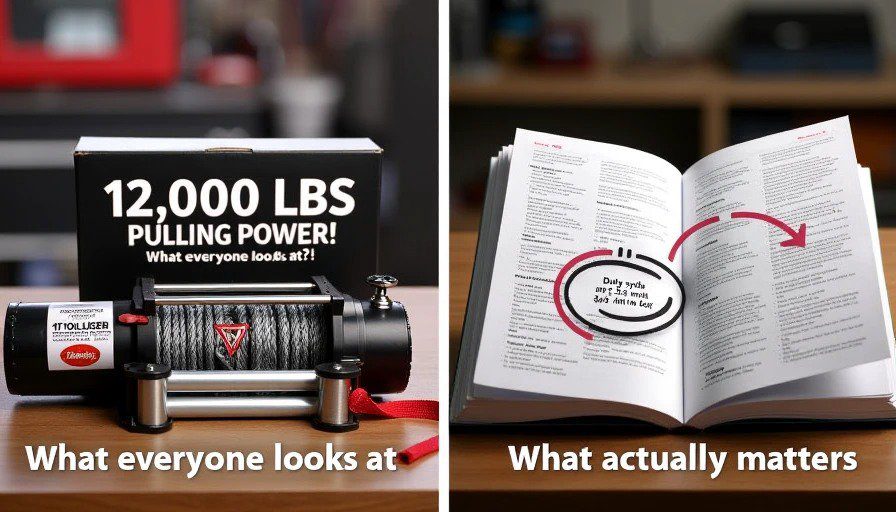
Everybody looks at the big number on the box. The one with the bold font and the exclamation point.
9,500 LBS! 12,000 LBS OF PULLING POWER!
It's the first thing manufacturers put on the box because it's the first thing buyers look for. And it's the last thing you should care about.
I'm not saying the max pull rating doesn't matter. It matters. But it's like horsepower on a truck — the number alone tells you almost nothing about whether the vehicle actually works in the terrain you drive.
The real questions are in the fine print. Duty cycle. Line speed. Amp draw at full load. Heat management. The boring stuff nobody reads. The stuff that determines whether your winch gets you out of a hole or turns into a $1,200 paperweight ten feet from the rig you're trying to recover.
I've seen both happen. I've pulled the trigger on a cheap winch and regretted it. And I've seen $1,500 winches fail on their first real pull because nobody checked the fine print.
Here's what I wish someone had told me before I bought my first one.
Duty Cycle: The Number Everyone Ignores
Duty cycle is the amount of time a winch can run under load before it needs to cool down. It's usually expressed as a percentage or a time ratio. Most consumer winches are rated at 3 minutes on, 15 minutes off at full load.
That means three minutes of pulling. Fifteen minutes of sitting there, idling, letting the motor cool, while you stand there waiting.
Here's what that actually looks like in the real world:
You're stuck. You need to move the rig thirty feet. You spool out a hundred feet of line, double it back through a snatch block for extra pull (which halves your line speed, by the way), and hit the switch. Ten seconds. Twenty seconds. Thirty seconds. The rig moves a couple of feet. The motor is hot — not "warm," hot. You let it cool for a few minutes. Do another pull. Ten seconds. The rig moves a couple more feet. Another break. Another pull. You get the rig out in twenty minutes, and the winch motor is too hot to touch.
That's a successful recovery.
An unsuccessful recovery is when you skip the breaks. You keep pulling. The motor gets hotter. The thermal cutoff trips, or worse, the motor burns out. And now you're stuck, your winch is dead, and the sun is going down.
What to look for in the spec sheet:
Duty cycle at full load — any winch worth buying should list this clearly. Look for at least 3 minutes/15 minutes. Better ones are 5 minutes/15 minutes or 3 minutes/12 minutes.
Duty cycle at 50% load — this is often 10 minutes/15 minutes. Most real recoveries happen at less than full load, so this number matters more than the full-load number. A winch that overheats at 50% load after three minutes is a problem.
Thermal protection — does it have a cutoff that shuts the motor off before it cooks itself? Some do. Some just let you burn it up. Spend the extra money on one that protects itself from you.
Line Speed: The Difference Between "Gets There" and "Gets There Before Dark"
Line speed is exactly what it sounds like — how fast the cable moves. The spec is usually listed in feet per minute, and it's always given at two numbers:
No load: fast, looks impressive
Full load: slow, where it actually matters
Here's an example:
Brand | No Load (ft/min) | Full Load (ft/min) | Full Load Amps |
|---|---|---|---|
Winch A | 35 | 5 | 420 |
Winch B | 28 | 8 | 380 |
Winch C | 40 | 4 | 470 |
Brand C looks fastest on the shelf — 40 feet per minute at no load! But at full load, it's slower than Brand B and draws more amps while doing it. That means you're waiting longer, overheating your battery, and cooking the motor.
Here's the thing most people miss:
Line speed matters more at low load than at full load. Why? Because most recoveries aren't "buried to the frame." Most recoveries are "I'm high-centered on a rock" or "I slid off the trail into a ditch." You need a moderate pull, not a max pull. And at moderate pull — say 5,000 lbs — the difference between 8 ft/min and 12 ft/min is the difference between a five-minute recovery and a ten-minute recovery.
Ten minutes of the winch running. Ten minutes of heat building up. Ten minutes of amp draw on your battery.
What to look for:
Full-load line speed over 5 ft/min — anything slower is going to be painful
Partial-load line speed over 10 ft/min — this is where you'll actually spend most of your time
A winch that doesn't fall off dramatically — some winches are fast at no load and a crawl at full load. The better ones maintain decent speed across the load curve. Look for graphs, not just two numbers.
Amp Draw: The Battery Killer Nobody Mentions
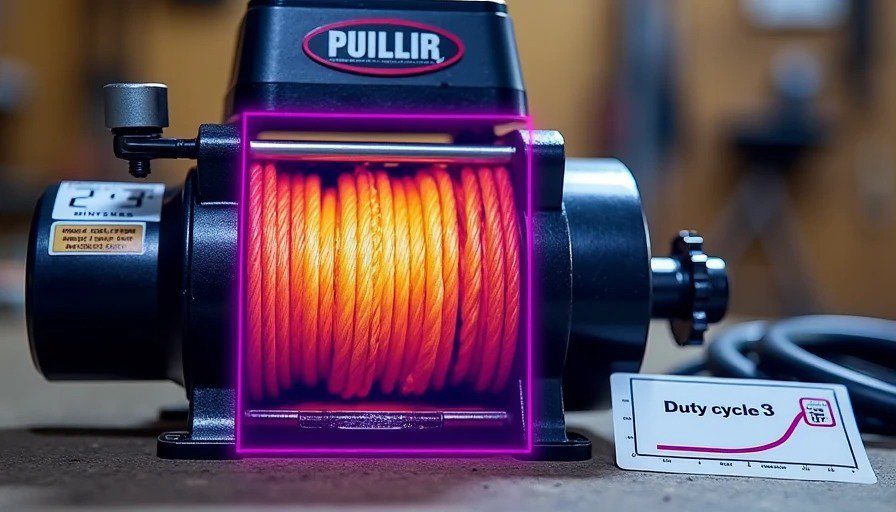
Here's a number that's almost never on the box:
How many amps does this winch pull at full load?
Some manufacturers bury it in the manual. Some don't list it at all. And some list a number that's measured in perfect lab conditions — not in the real world.
Here's what actual amp draw looks like for a typical 12,000-lb winch:
Load | Amps |
|---|---|
No load | 60-80 |
5,000 lbs | 250-300 |
8,000 lbs | 350-400 |
12,000 lbs | 450-500 |
Now think about your electrical system. A stock alternator on a midsize SUV puts out 100-140 amps at idle. Your battery has maybe 80 amp-hours of capacity. You're drawing 400 amps on a system that can deliver maybe 150 continuously.
What happens?
The winch pulls power from the battery. The battery pulls power from the alternator. The alternator can't keep up, so the battery drains. The voltage drops. The winch motor slows down. It draws even more amps to compensate — and the cycle continues until your battery is dead and your winch is barely turning.
That's why people run dual batteries. Not because they need the extra capacity. Because they need a dedicated winch battery that can deliver 400 amps without dropping voltage so low that everything else stops working.
What to actually look for:
Full-load amp draw in the spec sheet — if it's not there, email the manufacturer. If they won't tell you, don't buy it.
A winch that's reasonable for your alternator — if your alternator is 100 amps and the winch draws 450 at full load, you're going to have problems. You need a bigger alternator, a second battery, or both.
How long it can sustain that draw — a good winch will list a "duty cycle at amps" chart. A cheap one will just say "works with 12V systems."
The Fine Print You Actually Need to Read
Here's the part of the manual nobody reads. The part that matters more than the big number on the box.
1. "Duty cycle at 100% load" — what's the actual number?
Some winches don't list this at all. That's a red flag.
3 minutes / 15 minutes is the minimum acceptable. Anything less, walk away.
5 minutes / 15 minutes is better. You can do a serious recovery without sitting around for half an hour.
2. "Motor type" — series-wound vs. permanent magnet
Series-wound motors are older tech but draw less current at full load and handle heat better. Heavier, but tougher.
Permanent magnet motors are more common now — lighter, faster, but they demagnetize if they get too hot. Then they're useless. If you're in a hot climate or do long pulls, go series-wound.
3. "Gear train" — planetary, worm, or spur
Planetary gears are the most common in modern winches. Reliable, efficient, pack more torque in a smaller housing.
Worm gears are self-locking — they won't unwind on you. But they're slower and less efficient. Old-school, but still around.
Spur gears are older tech, noisier, less efficient. Don't buy one unless you're restoring a vintage rig.
4. "Water sealing" — IP rating or equivalent
Winches live on the front of your truck. They get wet. They get muddy. They get snow and salt.
If the spec sheet doesn't say anything about water resistance, assume it's not water-resistant.
Look for O-rings on the motor housing, sealed terminals, and a drain hole at the bottom of the drum housing.
5. "Wire rope vs. synthetic" — the choice that matters
This one deserves its own section.
Wire Rope vs. Synthetic Rope: Which One Should You Run?

The short version:
Factor | Wire Rope | Synthetic Rope |
|---|---|---|
Weight | Heavy | Light (1/3 the weight) |
Safety | Dangerous when broken | Safer — less stored energy |
Durability | Handles abrasion, rocks | Abrasion-sensitive |
UV Resistance | Fine | Degrades in sunlight |
Heat Resistance | Fine | Melts at moderate heat |
Ease of use | Stiff, harder to handle | Flexible, easy to handle |
Cost | Cheaper | More expensive |
I run synthetic on my rig. Here's why:
It's safer. When wire rope breaks under load, it whips back with lethal force. Synthetic just drops. Still dangerous, but less likely to kill you.
It's lighter. That matters on the front of the truck — less weight on the front axle.
It's easier to handle. You can splice it, knot it, work with it bare-handed.
It doesn't rust. Wire rope rusts from the inside out. You can't see the damage until it breaks.
But synthetic has downsides:
It abrades. Drag it across a rock and it frays. You need a chafe guard or a slider.
It melts. If your winch drum gets hot, the synthetic line can fuse. Good winches with proper cooling help, but it's still a risk.
It degrades in UV. Cover it when you're not using it. That winch cover on the box? Use it.
My recommendation for 90% of overlanders: synthetic rope with a thick chafe guard and a winch cover. It's safer, easier, and worth the extra money. But if you wheel in sharp rock country or do heavy commercial recovery, wire rope makes sense.
Installing the Winch: What Everyone Screws Up
I've installed more winches than I can count. Here's what I see people get wrong, over and over.
1. The winch sits on the bumper with no gap
The winch needs airflow. If it's hard-mounted to a flat plate with no spacer, there's nowhere for heat to go. A 1/4-inch or 3/8-inch spacer under the winch mount can drop operating temperatures by 20 degrees. Every factory winch package I've seen includes one. Aftermarket kits often don't. Add it yourself.
2. The wiring gauge is too small
Every winch comes with a wiring kit. The cable is sized for the winch at the length of the kit. If you extend the cable, you need to go up in gauge or you're going to melt something. Voltage drop is real. A 400-amp draw on a #4 cable that's 20 feet long means a voltage drop of over a volt at the winch. That's the difference between a winch that works and a winch that stalls.
Use the gauge listed in the manual. Go bigger if you're extending. Crimp properly, not with a hammer and a prayer.
3. No solenoid box relocation
The solenoid box on most winches is attached to the winch itself. That puts it right in the airflow path — and right in the water spray. If you relocate it to a dry spot (inside the engine bay or up on the firewall), it'll last longer and be easier to service when you need to replace a solenoid.
4. The fairlead is wrong for your rope
Synthetic rope needs a hawse fairlead — smooth, no sharp edges.
Wire rope needs a roller fairlead — the rollers keep the wire from binding on the edge.
Don't mix them up. Wire rope will cut into a hawse fairlead. Synthetic will abrade on the sharp edges of a roller fairlead. Use the right one for the rope you're running.
5. No recovery points on the other end
The winch isn't useful unless you have something to attach it to. Make sure you have front recovery points that are actually mounted to the frame, not just the bumper. And check that the shackle is rated for your winch's load — a 12,000-lb winch needs a 12,000-lb or higher shackle rating.
A Real-World Recovery: What the Numbers Actually Look Like
Let's run through a real scenario. This happened last year on a Utah trip. A Land Cruiser, buried to the frame in sand on a washboard road. 8,000 lbs of vehicle, stuck hard. The sun was an hour from hitting the horizon.
Here's what the numbers actually looked like:
Winch: 12,000-lb rated, 5.5 ft/min at full load, 3 minute / 15 minute duty cycle
Battery: Single battery, group 31, 100 amp-hour
Alternator: 130 amps
Load estimate: The pull needed about 8,000 lbs — that's 75% of the winch's rating
Line speed at that load: About 9 ft/min
Amp draw at that load: 360 amps
The recovery needed a 20-foot pull. At 9 ft/min, that's just over two minutes of actual pulling. But we had to rig it: snatch block, shackles, tree strap, get the anchor right. That took twenty minutes. The winch ran for about two minutes total. The motor got hot — not critical, but hot. The battery voltage dropped from 12.6 to 11.8 during the pull. The alternator brought it back up after we idled for ten minutes.
What made it work:
The winch was rated high enough for the pull — 75% load, not 100%
The line speed was good — 9 ft/min got the truck out in a reasonable time
The battery was large enough to handle the amp draw
We took breaks. Didn't run it continuously.
The synthetic rope didn't abrade on the fairlead or the snatch block
What could have failed:
If the winch had a lower duty cycle (2 minutes / 15 minutes), the thermal cutoff might have tripped — not a disaster but an extra wait
If the battery was smaller, the voltage drop could have stalled the winch
If the alternator was smaller, we'd be losing charge faster than gaining it — ending with a dead battery and a still-stuck truck
The winch did its job because the system — winch, battery, alternator, rigging — all worked together.
What to Buy (and What to Avoid)
Avoid:
Winches with no duty cycle listed
Winches that don't state amp draw at full load
Winches with no thermal protection
Winches with a line speed under 4 ft/min at full load
Winches that come with wire rope but no fairlead spacer
Winches that don't have a reasonable warranty (1-year minimum, 3-5 years is better)
Anything where the brand name is a random string of letters on Amazon
Consider:
Brands that have been in the game for a while: Warn, Smittybilt, Badland, ComeUp, Superwinch
Winches with a proven track record — check forums (IH8MUD, Expedition Portal) for real-world feedback
A winch that's 1.5x your vehicle's GVWR, not 1.0x. A 9,500-lb winch on a 7,500-lb truck is marginal. Go 12,000.
Synthetic rope unless you're in sharp rock country
A wireless remote with a wired backup — wireless is great until it dies
A serviceable motor — if it burns out, can you replace the motor or brushes, or do you have to replace the whole winch?
What I currently run:
I'm not here to shill products. But I've been running a synthetic-rope winch from a major brand on my 4Runner for five years now. It's been through dozens of recoveries, in sand, snow, mud, and rocks. I've replaced the rope once (wear from repeated use), the solenoid once (corrosion from a flood crossing), and the motor is original. It's not the cheapest or the most expensive. It's the one that's reliable.
Your mileage may vary. But buy something with a track record.
The Takeaway
When you buy a winch, you're not buying pulling power. You're buying time — time to get unstuck, time to recover, time to make it home before dark.
Skip the number on the box. Look at the fine print:
Duty cycle: 3 minutes / 15 minutes minimum. 5 minutes / 15 minutes better.
Line speed: at least 5 ft/min at full load, 10 ft/min at partial load.
Amp draw: know what your electrical system can deliver. If the draw at full load exceeds your alternator's output at idle by a large margin, you need a bigger alternator or a second battery.
Rope: synthetic unless you're in rock country. And get a cover for it.
Install: spacer for airflow, correct gauge wiring, relocated solenoid box, correct fairlead, proper recovery points.
If you buy for the spec sheet and install carefully, the winch will work when you need it.
If you buy the cheap one and assume it'll figure itself out? It won't. And you'll be the one digging out the sand with a shovel while the sun disappears behind the hills.
What Goes on the Parts Graveyard Wall
Last year, I pulled a winch off a buddy's truck that had been through a washout recovery. The winch was rated at 10,000 lbs — 5,000-lb truck, plenty of margin. But the duty cycle was 1 minute on, 15 minutes off, and the amp draw at 8,000 lbs was 420 amps on a stock battery and 100-amp alternator.
He ran it until it stopped. Four minutes in a row. Buried in sand. 8,000 lbs of load. The thermal cutoff never tripped — because it didn't have one. The motor cooked itself. He burned a 3/8-inch terminal off the solenoid, cracked the motor housing from thermal expansion, and melted the battery cables.
The winch was three months old. Out of warranty because he'd installed it himself with a missing spacer and 20 feet of undersized cable.
That winch is on my Parts Graveyard wall now. Tag says: "June 2023. Utah. 105 degrees. 8,000 lbs of sand. 1-minute duty cycle. 42 minutes from pavement. Cause of death: the fine print."
Don't be that guy.