An off road jack is not garage decoration. When a tire is buried to the axle housing outside Moab or a control arm is sitting on a rock in the Coconino National Forest, the jack becomes part of your recovery system. Pick the wrong one and you can turn a simple tire change into a 600-pound problem with sharp edges. I have used bottle jacks, Hi-Lift-style farm jacks, and compact hydraulic models on rigs from stock Tacomas to loaded Land Cruisers. If it has not broken in the backcountry, I do not recommend it.
What an off road jack actually needs to do
Start with the rig, not the product photograph. A 4,500-pound Jeep Wrangler carrying camping gear needs a different setup from a 7,500-pound diesel Ram with a steel bed rack. You are not lifting the entire vehicle, but the jack still needs enough capacity for one corner, plus a margin for uneven ground and shifting weight. I generally want a rated capacity of at least half the vehicle's loaded weight, although the lift point and chassis design matter just as much.
Lift height is the next number to check. A factory scissor jack might reach a stock crossover's pinch weld, but it can be useless when 35-inch tires and a suspension lift leave the axle hanging well below the frame. A bottle jack often offers strong capacity in a short package, while a farm-style jack can reach much higher. Neither is automatically better. The right choice reaches your actual lift points without forcing you to stack rocks, wood, or loose equipment underneath it.
An off road jack also needs a stable base. Sand, gravel, mud, and tilted rock are where cheap equipment gets honest. A narrow jack foot can sink before the tire leaves the ground. Carry a steel base plate or a thick section of hardwood, and keep it large enough to spread the load. A base does not make an unsafe lift safe, but it can stop the jack from disappearing into soft soil.

Bottle jack, farm jack, or portable floor jack?
A heavy-duty bottle jack is my first choice for many built rigs. It is compact, carries serious weight, and stores beneath a seat or inside a recovery box. Brands such as Torin and Pro-Lift offer common capacities from 6 to 12 tons. The catch is height. Measure the distance from your planned contact point to the ground with a fully deflated tire. If the jack cannot start low enough, its impressive capacity is irrelevant.
The farm-style jack, often called a Hi-Lift, earns its place when you have steel bumpers, rock sliders, or dedicated lift points. It can pull a vehicle sideways from a rut, lift a wheel high enough for suspension work, and act as a manual winch in limited situations. It also has a long, exposed mechanism that needs cleaning and inspection. On a trip through dusty Arizona country, I have seen the climbing pins refuse to seat because grit packed around the runner. That is not a product defect; it is neglected equipment.
A portable floor jack is the easiest tool to use on a hard surface. A low-profile model rolls smoothly and gives precise control, but most are too bulky for serious overlanding. The aluminum racing jacks from companies such as Arcan or Daytona can save time in a driveway, yet their wheels and frames are not designed for loose trail surfaces. I carry one in the shop and use a bottle jack on remote routes.
The failure points people overlook
The jack itself is only half the system. Inspect the saddle, handle, release valve, welds, and extension screw before every long trip. A bent handle is annoying in a driveway and nearly useless when you are kneeling in mud. Look for hydraulic oil around the ram. A small leak can become a no-lift situation after repeated use.
Your lift point deserves equal attention. A Hi-Lift saddle on a thin factory bumper can bend sheet metal. A bottle jack under an axle tube can damage a brake line, differential cover, or sensor wire. Read the vehicle manual, then verify the point visually. On a Toyota 4Runner, I prefer a solid axle or frame location that keeps the jack clear of the lower control arm and brake plumbing. On a solid-axle Jeep, the axle tube is usually practical, but the differential housing is a poor substitute for a flat, supported contact area.
An off road jack should never be the only thing holding a vehicle up. Chock the opposite wheels, set the parking brake when appropriate, and use rated jack stands if you are doing more than changing a tire. Never crawl under a vehicle supported only by a hydraulic jack or farm jack. A tire change beside the trail is one problem; retrieving a body part is another.
How I pack and use one in the field
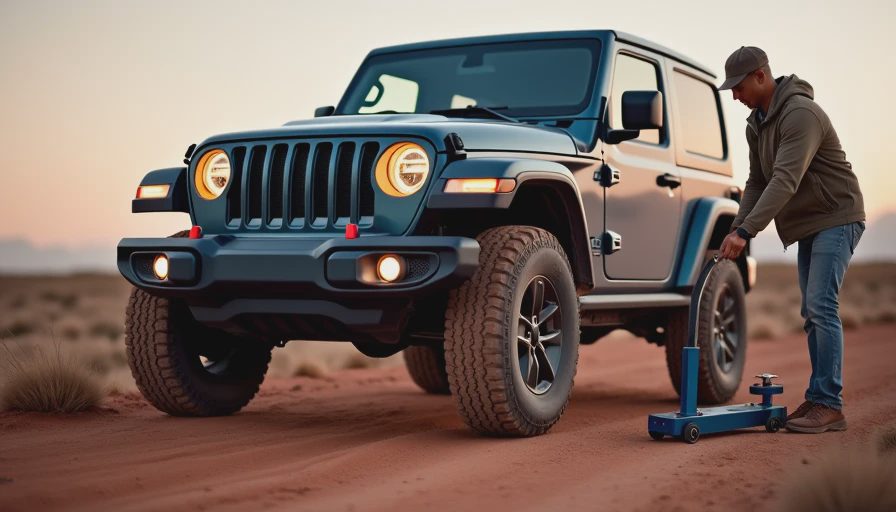
I store the jack where I can reach it without unloading the entire truck. Mine rides in a sealed recovery case with a base plate, short wood block, gloves, and a small wire brush. The jack handle is secured separately so it cannot rattle against the hydraulic cylinder. Before departure, I cycle the jack through its full range and wipe the ram clean.
At the breakdown, I first reduce stress on the vehicle. The transmission goes into park or gear, the parking brake is applied, and the opposite wheels get chocks. I clear loose rocks from the contact area, place the base, and test the jack with light pressure. If the base tilts, I reset it immediately. I do not try to correct a leaning jack while the tire is already off the ground.
For a bottle jack, I lift only until the tire clears the surface, then place the spare beneath the frame as an emergency backup while working. For a farm jack, I keep my head and hands away from the handle path. Those handles can kick with enough force to break fingers. Lower slowly, standing to the side, and keep everyone else outside the working area.
My practical setup for common rigs
A lightly modified Subaru or crossover usually benefits from a compact bottle jack, a broad base, and a factory-approved lift point. Do not assume the stock jack remains useful after installing larger tires. Test it at home before the first forest road trip.
For a Wrangler, Tacoma, 4Runner, or similar midsize 4x4, I favor a 6- to 12-ton bottle jack paired with a steel plate and a dedicated recovery jack point. Add a farm-style jack only if the vehicle has compatible steel lift points. Without those points, the long jack is mostly expensive trail clutter.
A full-size truck carrying a slide-in camper needs more capacity and more careful positioning. A 12-ton bottle jack can be sensible, but measure the loaded height first. A second jack is useful redundancy, not permission to lift two corners at once. Keep the spare tire accessible, because the best off road jack cannot help if the replacement tire is buried under 150 pounds of cargo.
The final check before you buy
Write down the loaded vehicle weight, lowest and highest lift-point measurements, and the storage space available. Then compare those figures with the jack's real specifications, not just the headline capacity. Confirm that the saddle fits your axle or frame, the base works on dirt, and replacement seals or parts are available.
I also recommend practicing a complete tire change in the driveway after dark. Use the same gloves, tools, base, and jack you carry on the trail. That exercise exposes missing adapters, short handles, and storage mistakes while the nearest light switch is still available.
A reliable off road jack is simple equipment, but simple does not mean casual. Buy for your loaded rig, protect the base, inspect the mechanism, and rehearse the job before a puncture forces the lesson. On the trail, boring equipment is good equipment. If it has not broken in the backcountry, I do not recommend it.