A good 100 Series Land Cruiser does not need a sales pitch. It needs a cold start at 6,000 feet, a loaded climb through loose rock, and enough mechanical honesty to get home. This 2004 Toyota Land Cruiser 100 series off road review comes from that angle. I am interested in the truck after the bumper gets scraped, the tires are aired down, and the nearest cell signal is several miles behind you.
The 2004 model sits in a useful spot for buyers. It has the mature UZJ100 platform, a strong V8, independent front suspension, a solid rear axle, and enough interior room for real travel. It is not a lightweight rock buggy. It is a heavy expedition wagon that can cover pavement, washboard, sand, and moderate technical trails without making the occupants miserable.
What the 2004 Toyota Land Cruiser Gets Right Off Road
The first thing you notice is composure. A stock 2004 Toyota Land Cruiser 100 series off road review can sound boring because the truck rarely does anything dramatic. That is the point. The suspension works progressively, the wheelbase is stable on climbs, and the long body gives you room for tools, water, recovery gear, and a sleeping platform.
The 4.7-liter 2UZ-FE V8 is not a high-revving sports-car engine. It makes useful low-end torque and has a reputation for surviving neglected road miles when maintenance is not ignored. Throttle response is predictable, which matters when a loose ledge is trying to turn one tire into a smoke machine. With proper gearing and sensible tires, the truck will walk through terrain that exposes weaker cooling systems and tired driveline parts.
The independent front suspension is also more capable than the internet sometimes admits. It keeps the truck planted and steers accurately across corrugated roads. You give up some articulation compared with a solid-front-axle rig, but you gain control and comfort over hundreds of miles. On an overland route, that trade is usually worth making.
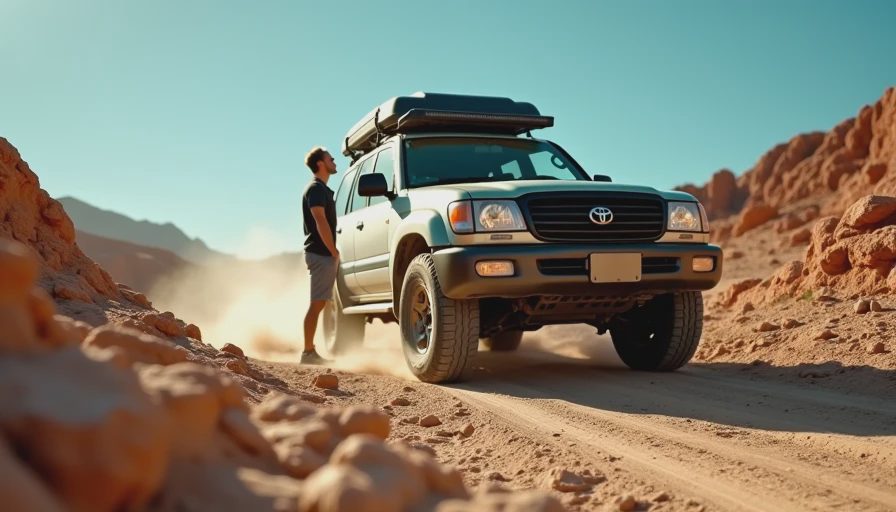
The Parts That Decide Whether It Comes Home
Here is where this 2004 Toyota Land Cruiser 100 series off road review stops being polite. Age is now the main enemy. A clean-looking truck can still have twenty years of dried rubber, overheated fluids, and deferred service underneath it.
Start with the timing belt. The 2UZ-FE uses a belt, and replacement is scheduled maintenance rather than an optional upgrade. If the seller cannot document the belt, water pump, tensioner, and idlers, price the job before you buy. A complete service often lands around $900 to $1,600 at an independent shop, depending on parts and local labor. Doing it yourself costs less but still requires patience and the correct locking procedure.
Inspect the lower ball joints closely. Failure can allow the steering knuckle to separate, which is not a roadside inconvenience. It is a recovery call. Check the front wheel bearings, CV boots, steering rack leaks, and every rubber bushing you can see. On a high-mileage truck, worn control-arm bushings can make the front end wander and can chew through tires after a lift.
The automatic transmission deserves a real road test. Look for delayed engagement, harsh shifts, slipping under load, or fluid that smells burned. Transfer-case operation should be verified in the driveway, not assumed because a dashboard light comes on. A light can tell you the computer saw something. It cannot prove the actuator completed the shift.
Suspension, Tires, and Ground Clearance
The best first modification is not a giant lift. It is a baseline service. Replace worn shocks, repair leaks, grease the driveline, align the truck, and measure ride height before ordering parts. A tired stock suspension can make a good Land Cruiser feel worse than a properly maintained one with smaller tires.
For most travel, a modest two-inch lift and a quality 32- or 33-inch all-terrain tire are enough. Brands such as Falken Wildpeak, BFGoodrich All-Terrain T/A KO2, and Toyo Open Country A/T are common choices, but tire load rating and actual weight matter more than the logo. A fully equipped 100 Series can become heavy quickly. Roof tents, steel bumpers, drawers, water, and spare fuel all push the suspension harder.
Do not chase clearance with a tall lift alone. The independent front suspension loses usable geometry as you add height. CV angles become steeper, alignment range gets tighter, and expensive parts live a harder life. On the trail, careful tire placement and a small amount of momentum beat a dramatic suspension number printed in an advertisement.
The 2004 Toyota Land Cruiser 100 series off road review also has to mention belly clearance. The transfer case and fuel tank deserve protection, but armor adds weight. A properly fitted aluminum or formed-steel skid system is usually more useful than a massive plate package that turns every trip into a weight penalty.

How It Performs on Real Trails
On forest roads and desert two-track, this truck is excellent. It tracks straight, carries a heavy load without feeling nervous, and has enough cabin insulation to make a long approach tolerable. At the start of an Arizona trail, I would rather spend six hours in a maintained 100 Series than in a stripped-down short-wheelbase rig with nowhere to put a cooler.
On rocky ledges, the limits show up clearly. The long wheelbase can hang up at breakover, and the front differential does not appreciate careless tire placement. If the truck has the optional factory locking differential, confirm that it engages before depending on it. If it does not, traction control can help, but heat and brake wear become part of the equation.
Sand requires tire pressure discipline. Start conservatively, lower pressure in controlled steps, and carry a compressor capable of restoring pressure before pavement. The truck is heavy enough that driving at highway pressure in soft sand is a reliable way to bury it. Recovery boards, a shovel, and rated recovery points are not decoration on this platform.
The answer to this 2004 Toyota Land Cruiser 100 series off road review is strongest when the goal is distance rather than spectacle. It is built to keep moving, not to win a rock-crawling contest.
What I Would Inspect Before Buying One
Bring a flashlight, a scan tool, and enough time to get underneath. Check the frame for corrosion, especially around suspension mounts and areas that hold mud. Look at oil seepage around the engine, transmission, transfer case, and differentials. A damp surface is different from an active leak, but both belong in the price conversation.
Test every electrical feature. The power windows, sunroof, climate control, seat controls, and dashboard displays are expensive little distractions when they fail. Check whether the air-conditioning blows cold at idle and during a long test drive. Inspect the radiator and cooling fans because overheating a 2UZ-FE can turn a dependable truck into a very expensive project.
Review service records for timing-belt intervals, fluid changes, brake work, and suspension repairs. A $14,000 truck with recent documented maintenance can be a better buy than a $9,000 example needing tires, brakes, belts, bushings, and steering work. I have watched buyers spend the difference in a single season because the cheap truck looked clean under fluorescent lights.
The Sensible Build Path
I would build this vehicle in stages. First, fix maintenance and safety items. Second, install recovery points, a compressor, quality tires, and basic underbody protection. Third, add suspension only after measuring the loaded ride height. Fourth, improve storage and electrical systems based on actual trips.
Budget roughly $2,000 to $4,000 for a serious baseline on a neglected example, before major rust or transmission work. A careful owner can spread that cost across a year instead of buying every accessory on the first weekend. Keep the factory spare-tire location if possible, protect the wiring from abrasion, and carry spare belts, fuses, fluids, and a front CV axle if the truck travels far beyond help.
My final 2004 Toyota Land Cruiser 100 series off road review is simple: buy condition, not badges or lift height. A maintained truck with modest upgrades is a dependable overland tool. A neglected truck with a roof tent and aggressive tires is just a heavier recovery problem. If it has not broken in the backcountry, I do not recommend it.