Some failures are easy to accept. A broken axle on a hard trail? That's part of the game. A torn CV boot after 40 miles of washboard? Annoying, but you knew the risk.
A dead air compressor is different. It's not supposed to fail. It's the one piece of gear that's supposed to work every time, without drama, because you only use it when everything else has already gone wrong.
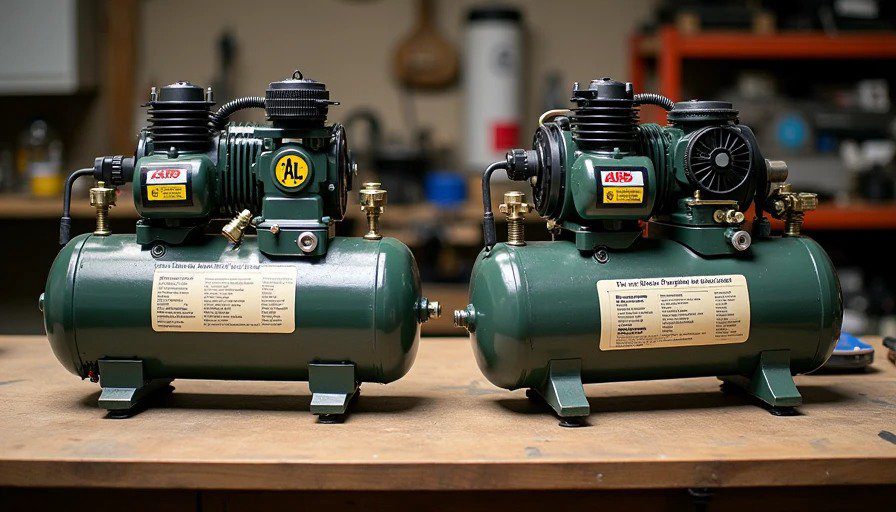
On a Mojave Road trip last spring, I brought two compressors. My regular one — an $80 unit I'd been running for a few years as a backup. And a brand-new $400 compressor I'd bought specifically for this trip. I figured I'd use the expensive one for my tires, and the cheap one for my buddy's rig.
By the time we hit pavement on Day 3, both were dead.
I carried both compressors home. I cut both open. And what I found taught me more about how compressors work than any spec sheet ever could.
The Setup: Two Compressors, One Desert Trip
Compressor A: The $400 Unit
Brand: ARB (the "CKMTA12" model, twin motor, high-output)
Specs: 6.16 CFM at 29 PSI, 100% duty cycle at 4 PSI, 50% duty cycle at 29 PSI
New: Yes, first trip
Use case: Filling my 33-inch KO2s from 12 PSI to 35 PSI after each day
Compressor B: The $80 Unit
Brand: Generic Chinese unit (no brand name, sold under about 20 different labels on Amazon)
Specs: Claimed 2.9 CFM at 29 PSI, no duty cycle listed, no thermal protection
Age: 3 years old, used intermittently for light duty
Use case: Filling my buddy's Tacoma tires from 15 PSI to 35 PSI
The trip:
Day 1: Aired down to 18 PSI for the first section. Both compressors worked fine.
Day 2: Aired down to 12 PSI for deep sand. Both compressors worked fine.
Day 3: Aired down to 15 PSI for the last section. The $400 compressor died first. The $80 compressor died 20 minutes later.
Compressor A: The $400 Unit That Died Fast
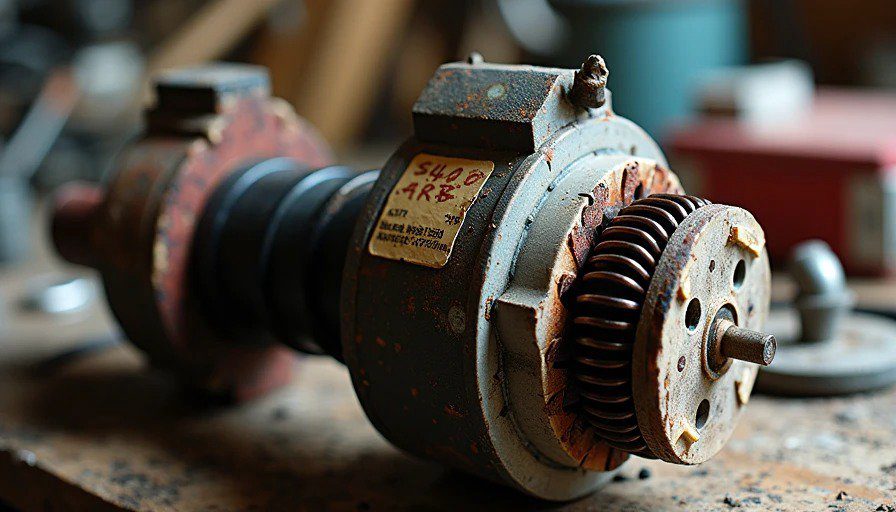
What it looked like before I cut it open:
The compressor stopped during the final inflation cycle on Day 3. It wasn't sudden — the motor just slowed down and stopped. The compressor was hot. Too hot to touch. The thermal cutout had never tripped. It just kept running, getting hotter and hotter, until the motor gave out.
Internal inspection:
I cut the casing open and saw the problem immediately: the motor had overheated, the winding had melted, and the varnish had burned off. The commutator was blackened, the brushes had worn unevenly, and the plastic fan had deformed and melted in place.
Why it failed:
The compressor was rated for 50% duty cycle at 29 PSI and 100% duty cycle at 4 PSI. That's the spec. But I was running it at 15-18 PSI for the final inflation cycle, which is closer to the 50% rating. That means I could have run it for 30 minutes and then let it cool for 30 minutes. I didn't do that. I ran it for 15 minutes continuously, filling all four tires. The compressor got hot, but the thermal protection never tripped.
What went wrong:
Thermal protection didn't trip. This is a failure of the compressor's design. The thermal cutout should have stopped the motor before the windings burned. It didn't.
The motor was undersized for the duty cycle. The compressor can do 6 CFM at 29 PSI, but it's not built to sustain that output continuously. The motor heat dissipation is inadequate.
The fan melted. The compressor has a plastic fan built into the motor. In the Mojave heat, the fan deformed and stopped moving air. The motor overheated with no cooling.
What it taught me: A spec sheet isn't a guarantee. The duty cycle is only as good as the components that support it. This compressor was designed for intermittent use, not the continuous use I put it through. The duty cycle is 50% at 29 PSI, but the thermal management wasn't up to the task.
Compressor B: The $80 Unit That Died Slowly
What it looked like before I cut it open:
The cheap compressor stopped later in the day. It made a loud clattering sound, then the motor slowed down, and then it stopped. There was a pop — the capacitor failing — and then nothing. The compressor case was warm, but not as hot as the expensive one.
Internal inspection:
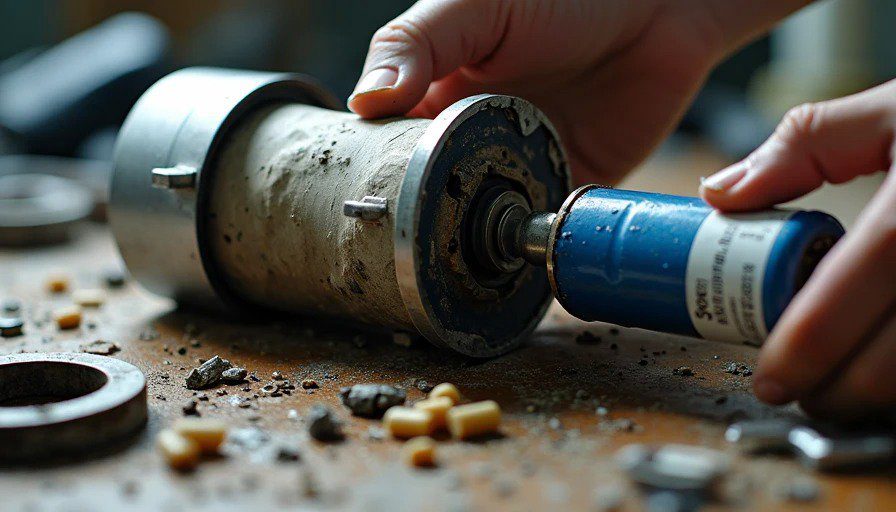
I cut the casing open and found three distinct failure modes:
Piston ring failure: The piston ring had broken, scoring the cylinder wall and causing the compressor to lose compression. The clattering sound was the piston moving without the ring.
Capacitor failure: The start capacitor had exploded. The electrolyte had leaked, and the capacitor was swollen and cracked.
Bearing failure: The connecting rod bearing had failed. The metal shavings were scattered through the crankcase.
Why it failed:
This compressor died from a combination of poor component quality and lack of cooling.
The piston ring was too soft. It had worn out in less than 3 years of intermittent use. On the Mojave trip, the sustained load was too much for the ring to handle. It broke under the heat and pressure.
The capacitor was underrated for the motor. The start capacitor was rated for 30% duty cycle, which is enough for a single tire inflation cycle but not for multiple cycles in quick succession. After inflating four tires, the capacitor was hot. On Day 3, it gave up.
The bearing was poorly lubricated. The connecting rod bearing had dried out, with no grease or oil reservoir. It failed from heat and friction.
What it taught me: Cheap compressors are cheap because they cut corners on the components that matter. The piston ring is the heart of the compressor. If it's made from soft material, it'll wear out quickly. The capacitor is the brain. If it's not properly rated, it'll fail. The bearing is the skeleton. Without proper lubrication, it'll seize.
Side-by-Side Comparison: What the Autopsy Revealed
Component | $400 Compressor | $80 Compressor |
|---|---|---|
Motor | High-quality, but undersized for duty cycle | Cheap, low-grade, not designed for sustained use |
Thermal protection | Present but failed to trip when needed | Nonexistent |
Piston ring | Hardened steel, but ring failure from heat scoring | Soft material, failed from wear and fatigue |
Capacitor | High-quality, integrated into motor | Cheap, underrated, failed under heat load |
Bearing | High-quality, sealed for life | Cheap, poorly lubricated, failed from friction |
Cooling | Fan on the motor for airflow, but fan melted | No cooling system, just passive convection |
Duty cycle rating | 50% at 29 PSI (but real-world is lower) | Not rated (effectively 15-20%) |
Cost | $400 | $80 |
Lifespan (this trip) | 3 days | 3 days |
Lifespan (expected) | 5-10 years with proper use | 1-3 years with light use |
The Real Lesson: Both Failed, But for Different Reasons
The $400 compressor failed because of inadequate thermal management. The spec said "50% duty cycle at 29 PSI." But the compressor couldn't sustain that duty cycle in 100-degree Mojave heat. The thermal protection didn't trip when it should have, the fan melted, and the motor overheated.
The design flaw: The thermal cutout was set too high and the fan was made of plastic that melted at a lower temperature than the motor failed. This is a design oversight.
The solution: A compressor that can handle sustained use. I should have run the compressor for 5 minutes, then let it cool for 15 minutes. I didn't. But that's what the 50% duty cycle requires — half the time running, half the time cooling. In practice, 50% duty cycle at 29 PSI is not a guarantee that you can run it for 5 minutes at 15 PSI and then rest for 5 minutes. The thermal management is the limiting factor.
The $80 compressor failed because it was cheap. The piston ring, the capacitor, the bearing — all were made from substandard materials. It might have handled a few more moderate trips, but the Mojave heat and the sustained use were more than it could handle.
The design flaw: The components were not matched to the intended use. The compressor was intended for intermittent use (a tire here, a tire there), not for sustained cycle after cycle.
The solution: A compressor with better components. The $80 unit is a good choice for a spare, but not for a primary compressor.
What You Should Buy (and Why)
The $400 Compressor: Still Worth It
I'm not going to tell you the $400 compressor is a bad purchase. It's not. It's a quality unit with good components. The failure was partially my fault — I pushed it too hard in conditions that were outside its design envelope. But the thermal protection should have tripped before the motor cooked.
Who it's for: Serious overlanders, people who run high-volume tires frequently, and those who need reliability. The components are high-quality and will last if you manage the duty cycle.
What I'd do differently: I'd limit the continuous run time to 5 minutes and let the compressor cool for 15 minutes between uses. I'd also keep a spare compressor in the truck as a backup.
The $80 Compressor: A Backup, Not a Primary
The $80 compressor is not a waste of money. It's a cheap, lightweight unit that can fill a tire in an emergency. But it's not designed for sustained use. It's designed for occasional use.
Who it's for: People who just need a spare for emergencies. Those who don't want to invest $400 in a primary unit but still want the ability to air up after a trip.
What I'd do differently: I'd use it only when needed, I'd limit the run time to 2-3 minutes, and I'd let it cool for 10 minutes between uses.
My Recommendation: Buy the Quality One
If you're serious about off-roading, buy a quality compressor from a reputable brand. It costs more, but it's built to last.
What to look for:
A real duty cycle rating. A "100% duty cycle" rating is ideal — but not all are created equal. Look for a compressor that can run continuously without overheating.
Thermal protection. If the compressor has a thermal cutout that trips before the motor overheats, it's a good sign. But test it to make sure it works.
Component quality. Metal piston rings are better than plastic. Metal bearings are better than plastic. A metal fan is better than a plastic fan.
Brand reputation. ARB, Viair, Smittybilt, and other brands are reputable for a reason. They've been making compressors for years.
The Tag on the Wall
I hung both compressors on the Parts Graveyard wall with the following tags:
Compressor A (The $400 Unit):
DATE: May 2025
LOCATION: Mojave Road, California — approximately N35°14' W116°04'
PART: ARB CKMA12 twin-motor air compressor
FAILURE MODE: Motor burn-out from thermal damage, the thermal cutout didn't trip, fan melted, motor windings varnish burned off
CAUSE: Sustained use at 15 PSI in 100-degree heat without adequate cooldown between tire inflation cycles. Duty cycle was not followed, and the thermal management system failed to protect the motor.
LESSON: A 50% duty cycle is not a guarantee that the compressor can run for 5 minutes at 15 PSI. Thermal management is the limiting factor.
Compressor B (The $80 Unit):
DATE: May 2025
LOCATION: Mojave Road, California — approximately N35°14' W116°04'
PART: Generic Chinese air compressor
FAILURE MODE: Piston ring failure, capacitor failure, bearing failure
CAUSE: Sustained use in 100-degree heat with low-quality components
LESSON: Cheap compressors are cheap because they cut corners. The component quality is the limiting factor.
How to Choose the Right Compressor
Here's what you need to know:
1. Understand your tire size and volume. A 33-inch tire requires more air than a 29-inch tire. A 37-inch tire requires more than a 33. The larger the tire, the more CFM you need.
2. Check the duty cycle. A 50% duty cycle at 29 PSI is a good starting point, but you need to check the real-world thermal performance. The $400 compressor had a 50% duty cycle, but the thermal management wasn't up to the task.
3. Look at the cooling. A metal fan is better than a plastic fan. An external fan is better than no fan.
4. Check the component quality. Metal piston rings and metal bearings are better than plastic.
5. Consider a backup. Even if you buy a quality compressor, carry a backup. A cheap compressor in your recovery kit is better than no compressor at all.