I've been to a lot of Overland Expos. The one in Flagstaff, the one in Colorado, the big one in Arizona. I've walked miles of vendor aisles, looked at thousands of rigs, and listened to more advice than I can remember.
Most of it is noise.
Every year, I come away with the same impression: there's a lot of shiny stuff out there, and most of it is designed to separate you from your money. But every year, I also find a few things that are genuinely worth paying attention to. A rig that's actually been used. A piece of advice that's actually useful. A product that actually solves a problem.
This year's expo was no different. I walked the aisles, talked to the vendors, and looked at the rigs. Here's what I came away with.
The Best Rig I Saw: A 1997 80 Series Land Cruiser
There were a lot of impressive rigs at the expo. Six-figure builds on 37s, long-travel suspensions, full drawer systems, rooftop tents, awnings, dual batteries, solar panels, and more lights than a stadium.
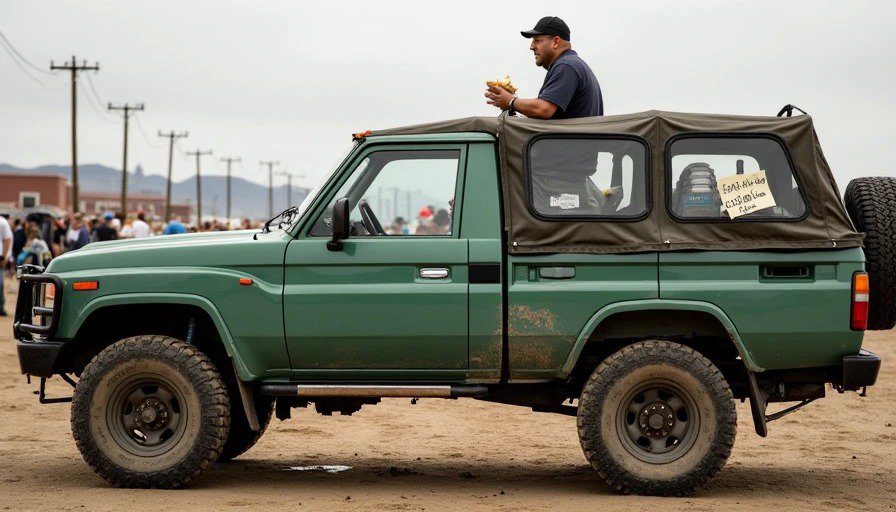
But the best rig I saw was a 1997 Toyota Land Cruiser 80 Series. It was parked in the back of the lot, away from the main display area, with a hand-written sign in the window: "For sale or trade. 240,000 miles. Runs great."
I walked over to take a look. The truck was faded green, with the paint worn through in spots. There was a dent in the rear quarter panel from a tree that had gotten too close. The windshield had a crack. The tires were 33-inch BFGoodrich KO2s with about 60% tread left, and they were covered in mud from the drive to the expo.
The owner, a guy named Mike, was sitting on the tailgate, eating a sandwich and watching the crowds walk by. He'd owned the truck for 12 years. He'd driven it from his home in Colorado to Baja, through the Mojave, across the Great Basin, and down the entire length of the Rockies. He'd crossed the Continental Divide four times. He'd never been towed.
The build:
Suspension: 2-inch OME lift, installed 80,000 miles ago
Tires: 33x10.5R15 KO2s on factory wheels
Gears: 4.88:1
Lockers: Factory front and rear e-lockers
Armor: ARB front bumper, factory skid plates
Recovery: Snatch strap, shackles, shovel, high-lift jack
Storage: Plastic bins in the rear, no drawer system
Sleeping: Ground tent
Electrical: Single battery, no fridge, no winch
I asked him what he'd do differently.
"Nothing," he said. "It works. I've been everywhere I wanted to go. I don't need a fridge or a rooftop tent. I don't need a winch. I don't need a dual battery system. I need a truck that starts every morning and gets me where I'm going. This truck does that."
He was asking $8,500 for it. I thought about buying it. I still think about it.
What made it the best rig: It was used. It was simple. It worked. It had been places. It had the scars to prove it. And it cost less than the suspension on most of the rigs in the main display area.
The Worst Advice I Heard: "You Need a Winch for Every Trip"
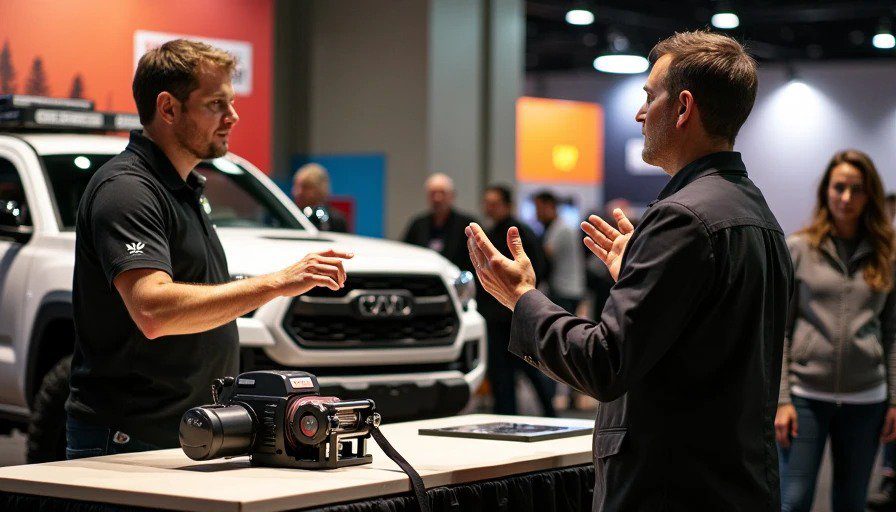
I was standing at a booth, listening to a vendor talk to a customer. The vendor was selling winches — expensive ones, the kind with all the bells and whistles. The customer was a guy with a brand-new Tacoma, stock suspension, all-terrain tires, and no trail experience.
"You need a winch," the vendor said. "You can't go off-road without a winch. What if you get stuck?"
The customer nodded. He looked nervous. He was about to spend $2,000 on a winch that he didn't need.
I stepped in.
"Hold on," I said. "What trails are you planning to run?"
The customer looked at me. "I don't know. Forest roads, I guess. Maybe some light trails."
"You don't need a winch for that," I said. "You need a snatch strap, a shovel, and a set of recovery boards. You can get all of that for under $300. If you get stuck on a forest road, the snatch strap and a friend will get you out. If you're solo, the recovery boards will get you out."
The vendor looked annoyed. The customer looked relieved.
"You're right," he said. "I don't need a winch."
The vendor tried to recover. "Well, you might need one later—"
"Later," I said, "he can buy one. Right now, he needs to learn how to drive on dirt. A winch is a tool, not a ticket to the trail."
Why this advice is bad: Winches are great tools, but they're not necessary for every trip. They're heavy, expensive, and require maintenance. For 90% of the trails that most people run, a snatch strap and a shovel are enough. If you're running solo in remote areas, a winch is a good idea. But if you're on a forest road, you don't need one.
The real advice: Buy a winch when you need it. Not before. And if you do buy one, learn how to use it. A winch is only as good as the operator.
The One Product I'd Actually Buy With My Own Money
I walked the entire expo, looking at every booth, every product, every piece of gear. Most of it was fine, but not worth the money. Some of it was overpriced. Some of it was under-engineered. Some of it was just flash.
But there was one product that stood out: a small, clever piece of kit that solved a problem I didn't know I had.
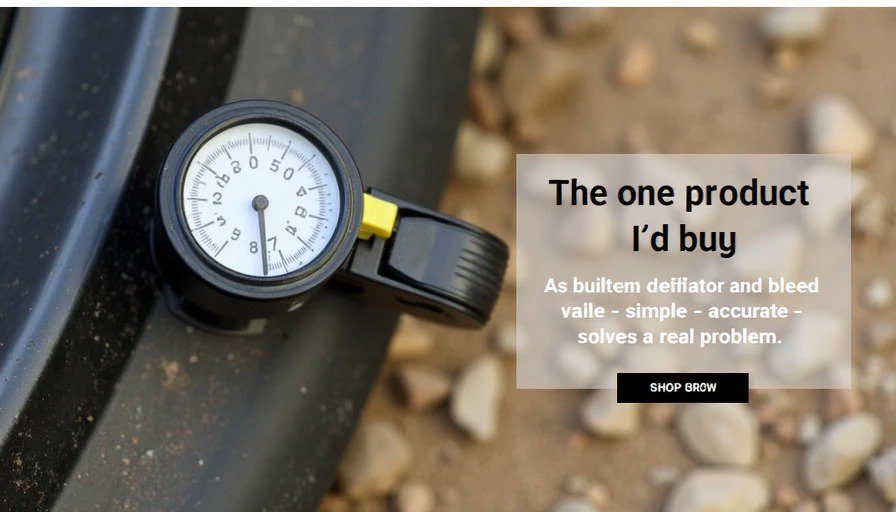
The product: A compact tire pressure gauge with a built-in deflator and a bleed valve. It's about the size of a permanent marker and costs $25.
The problem: Tire pressure management on the trail is a pain. You need a gauge, a deflator, and a way to bleed the air out quickly. Most gauges are bulky and hard to read. Most deflators are either too slow or too fast.
The solution: This little gauge clips onto the valve stem, reads the pressure, and lets you bleed air out with a simple button. It's accurate within 1 PSI and works in any weather.
Why I'd buy it: It's simple, affordable, and solves a real problem. It's not flashy. It's not expensive. It just works. I've used similar products before, and they save time and frustration on the trail.
What I'd skip: The $400 air compressor that promises to fill your tires in 30 seconds. The $800 rooftop tent that weighs 150 pounds. The $1,200 drawer system that adds 200 pounds to your truck. The $2,000 winch that you'll use twice in a decade.
What I'd buy: The $25 tire pressure gauge. The $50 recovery boards. The $100 snatch strap. The $20 shovel. The things that actually get used.
The Overland Expo Experience: A Reflection
Overland Expo is a great event. It brings together thousands of people who share a passion for the outdoors, for adventure, and for vehicles that can take them there. It's a chance to see the latest gear, talk to the experts, and meet other enthusiasts.
But it's also a commercial event. And the commercial aspect can be overwhelming. Every booth is trying to sell you something. Every rig is trying to impress you. Every piece of advice is trying to convince you that you need something you don't have.
Here's what I've learned from years of attending:
1. The best rig is the one that's been used. The trucks that are covered in mud and dust and have been all over the country — those are the best rigs. The ones that have never left the pavement? They're just parked.
2. The best advice comes from experience. The guy who's been driving the same truck for 12 years and has 240,000 miles on it? That's the person you want to listen to. The vendor who's trying to sell you something? Take their advice with a grain of salt.
3. The best product is the one that solves a problem. Not the one that looks cool. Not the one that has the most features. The one that actually solves a problem you have.
4. You don't need most of the stuff they're selling. The vast majority of the products at the expo are nice to have, but not necessary. You can get by with a lot less than you think.
5. The community is the best part. Overland Expo is a great place to meet people, share stories, and learn from others. That's the real value. The gear is secondary.
What I'm Taking Home
I've been to enough Expos to know the pattern. I'll spend a few days in the dirt with friends, walk the aisles, look at the rigs, talk to the vendors, and come back with a list of things I want.
But this year, I'm coming back with a different list. The things I actually saw that were worth my time and money:
A 1997 Land Cruiser that's been everywhere (reminder: simple works)
A tire pressure gauge that costs $25 (reminder: the best tools are often the cheapest)
A conversation with Mike, the owner of the Cruiser (reminder: the community is the best part)
And I'm leaving behind the $400 air compressors, the $800 rooftop tents, the $1,200 drawer systems, and the $2,000 winches. I don't need them. And if I ever do, I'll buy them then.
The Takeaway
Overland Expo is a great event. It's a chance to see what's out there, to talk to the experts, and to meet other enthusiasts. But it's also a commercial event, and you need to go in with your eyes open.
The best rig I saw was a $8,500 80 Series Land Cruiser that had been driven across the continent. The worst advice I heard was from a vendor telling a beginner he needed a $2,000 winch. The one product I'd buy with my own money was a $25 tire pressure gauge.
The lesson is simple: less is more. Simpler is faster. Cheaper is often better. And the best gear is the gear you actually use.
Don't let the expo convince you otherwise.