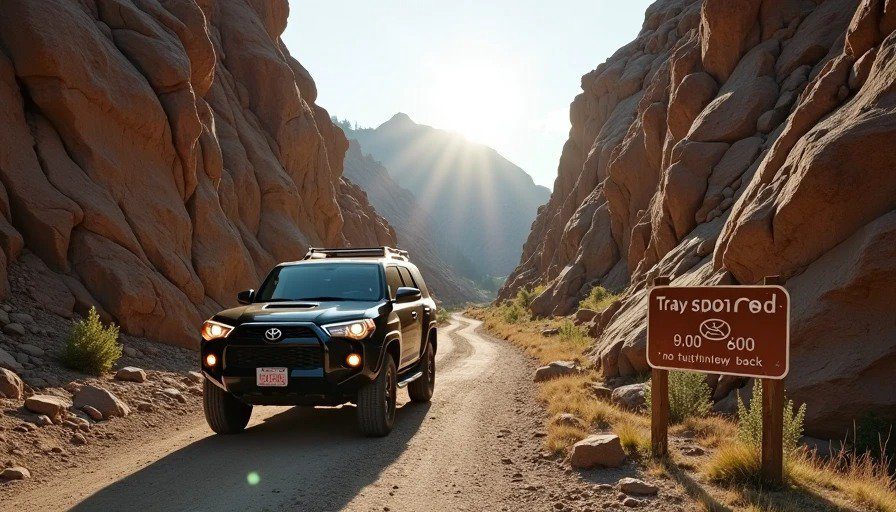
Some trips go exactly as planned. This one did not.
It was late October. I'd been running a solo route through the San Juan Mountains in southwestern Colorado. The aspen were past peak, the trails were empty, and the weather was holding — clear skies, cold nights, perfect for a last solo run before winter shut the high country down.
The route was simple: start near Silverton, head east on a network of Forest Service roads, and loop back toward Durango. I'd run variations of this route before. I knew the area. I had paper maps, a GPS, and a full tank of gas.
What I didn't have was cell service, a satellite communicator, or any other way to call for help. That was intentional. It was a solo trip, and I wanted to be self-reliant. I had recovery gear, tools, food, water, and warm clothes. If something went wrong, I was the one who had to fix it.
Something went wrong.
The Wrong Turn: How It Started
I was about 50 miles into the route, just past a junction that wasn't marked on my map. The road I'd been following split into two. The left fork looked like the main route — wider, more traveled, with signs of recent tire tracks. The right fork was narrower, rougher, and looked like it hadn't been driven in a while.
I took the right fork. I don't have a good reason for this. Maybe I was curious. Maybe I thought it would be a shortcut. Maybe I just wanted to see where it went.
The road started well. Packed dirt, moderate incline, decent traction. But it got narrower. And rougher. The trees closed in, and the road started climbing more steeply. The ground was rockier, with exposed boulders and ledges that required careful line choice.
I should have turned around. I should have backed up to the junction and taken the left fork. But I didn't. I kept going, thinking it would open up.
It did not open up.
The High Center: When the Road Stopped
The road ended. Not gradually, not with a turnoff, but abruptly. It just stopped at a rock wall, with no turnaround and no room to turn around. The road had been a dead end, and I'd driven all the way to the end.
I was stuck. Not in the sense of being stuck on a rock, but stuck in the sense of being at a dead end with no room to turn around. The only way out was to back up the entire way — about a mile of narrow, rocky road with no shoulder and no spots wide enough to turn around.
I started backing up. It was slow going — I had to pick my lines carefully to keep the wheels on the track and avoid the boulders that lined the edge of the road. About 200 feet into the retreat, I misjudged a line. The rear tire slipped off the track, the truck dropped onto a boulder, and I heard the unmistakable sound of metal scraping on rock.
The truck was high-centered. The front tires were off the ground, the rear axle was resting on the boulder, and the transfer case skid plate was grinding against a rock ledge. The truck wasn't moving in any direction without help.
I got out, assessed the situation, and realized I was in for a long night.
The Situation: What I Was Up Against
Altitude: 9,000 feet (the road had climbed to a ridgeline before the dead end)
Temperature: About 35 degrees when I stopped, dropping fast
Time: Around 4:30 p.m., with sunset at about 6:15
Terrain: Narrow, rocky road, with a steep drop-off on the driver's side and a rock wall on the passenger side
Vehicle: High-centered on a boulder under the rear axle, front wheels off the ground, transfer case skid plate contacting a rock ledge
Recovery gear: Warn 9.5xp winch with synthetic rope, a snatch block, two tree straps, four shackles, and a shovel
The challenge: I needed to lift the rear axle off the boulder and move the truck back onto the track. But the winch was on the front, and I needed to pull the truck backward. That meant using a snatch block to redirect the winch line to the rear.
The Recovery: Step by Step, in the Dark
Step 1: Assess, Breathe, and Plan
The first thing I did was get out, walk around the truck, and figure out exactly what I was dealing with.
The boulder was under the rear axle, between the axle housing and the track bar mount.
The transfer case skid plate was contacting a rock ledge about four inches below the frame.
The front tires were off the ground by about two inches.
The truck was stable, but it wasn't going anywhere without a lift.
I took a moment to breathe. Panic doesn't help. I'd been in sticky situations before, and I knew that the only way out was a methodical, step-by-step approach. I had the gear, I had the skills, and I had enough daylight to get set up before it got dark.
Step 2: Set Up the Winch for a Rear Pull
The winch was on the front of the truck. I needed to pull the truck backward to get the rear axle off the boulder and onto the track. That meant rerouting the winch line around the truck.
I used a snatch block to redirect the winch line. Here's how:
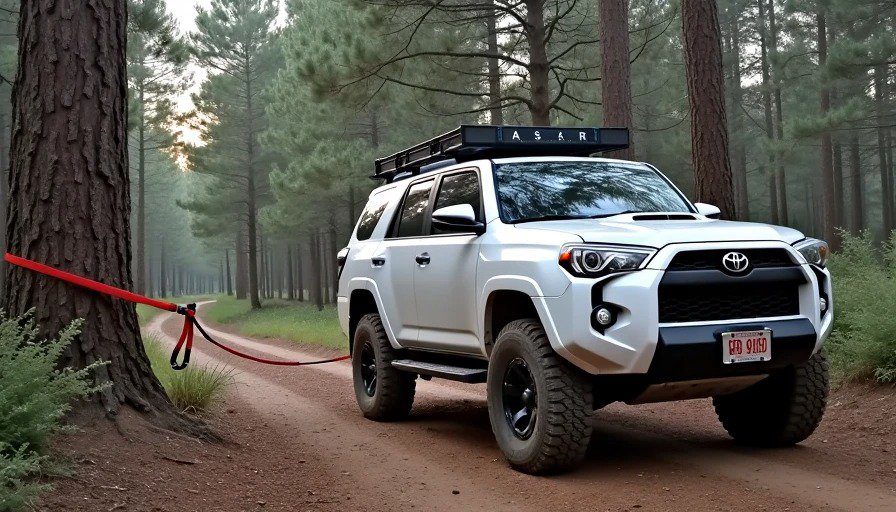
I ran a tree strap around the anchor point (a large pine tree about 50 feet behind the truck, on the uphill side of the road).
I attached the snatch block to the tree strap with a shackle.
I spooled out the winch line, ran it from the front of the truck, under the chassis (keeping it clear of the suspension and the boulder), and through the snatch block.
I brought the winch line back to the rear of the truck and attached it to the rear recovery point (a Class III hitch receiver with a shackle).
The setup doubled the winch's line length and gave me a straight pull backward from an anchor point behind the truck.
Step 3: Lift the Rear Axle
With the winch line rigged, I engaged the winch. The line tightened, the truck groaned, and I could feel the weight of the truck shifting onto the winch. The rear axle lifted off the boulder — just enough to break contact.
I held the winch tension and packed rocks under the rear tires. The track was soft, and I needed something solid for the tires to grip. I used rocks from the edge of the road, stacking them under the tires to give them a surface to bite.
Step 4: Move the Truck Backward
With the rear axle off the boulder and rocks under the tires, I let the winch pull the truck backward. The truck moved slowly, the tires climbing onto the stacked rocks and settling onto the track. I was back on the road.
But I wasn't out yet. The road was still narrow, and the truck was still at an angle. I needed to get it back onto the track and pointed in the right direction.
I repeated the process: winch the truck backward a few feet, stop, adjust the line, set rocks, winch again. Each pull moved the truck a few feet closer to the wider section of the road where I could turn around.
Step 5: Turn Around and Go Home
After about an hour of winching, I had the truck back on the track and oriented forward. The road widened enough to do a three-point turn, and I was facing the way I'd come.
I packed up the recovery gear, got in the truck, and drove down the road in the dark. The temperature had dropped to 28 degrees, but the heater was working, and I was moving.
I didn't see another vehicle on the road that night. I didn't expect to.
The Conditions: What 28 Degrees Feels Like
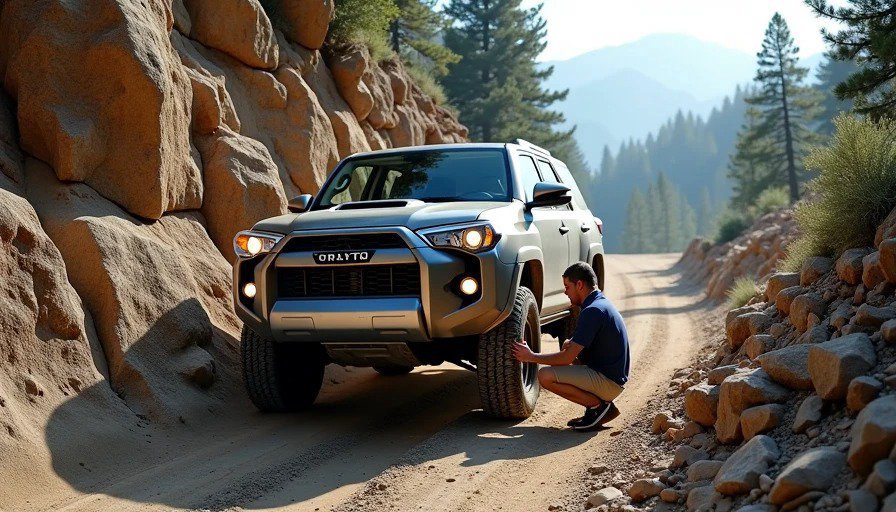
The temperature dropped fast. When I stopped at 4:30, it was about 35 degrees. By the time I finished the recovery at 7:00, it was 28 degrees. The wind had picked up, and the cold was seeping through my gloves and jacket.
What it felt like:
The metal: The winch rope was cold and stiff. My gloves gave me just enough dexterity to handle the shackles and the snatch block, but my fingers were numb by the end.
The ground: The rocks were cold. The dirt was cold. Everything was cold.
The truck: The engine was running, but the heater was struggling to keep up with the cold air.
The mental game: The cold made everything harder. My reactions were slower, my hands were clumsier, and I had to consciously slow down to avoid making mistakes.
What Worked: The Gear That Got Me Out
1. The winch.
The winch was the only reason I got out. It provided the pulling power I needed to lift the truck off the boulder and move it backward. The synthetic rope was easier to handle than wire rope in the cold, and it didn't kink or bind.
2. The snatch block.
I couldn't have done the rear pull without the snatch block. It allowed me to redirect the winch line to the rear of the truck without unspooling and rerigging from scratch.
3. The tree strap.
The tree strap gave me a solid anchor point at the rear of the truck. The tree was large enough to support the load, and the strap was long enough to reach the snatch block.
4. The headlamp.
I had a headlamp with a bright LED and a long battery life. It kept my hands free while I worked in the dark. I had a backup headlamp and a spare set of batteries, just in case.
5. The warm clothes.
I was wearing layers — thermal underwear, a fleece, a down jacket, and a windproof shell. My gloves were insulated but not bulky enough to prevent dexterity. I had a spare set of gloves in the truck, and I swapped them when they got wet.
6. The food and water.
I had snacks and water in the truck. I ate a protein bar and drank water during the recovery to keep my energy up.
What Didn't Work: The Gear That Let Me Down
1. The radio.
The radio was useless. I couldn't reach anyone. I wasn't expecting to, but I was surprised by the complete lack of signal. I was in a canyon, surrounded by rock walls, and the radio was just static.
2. The GPS.
The GPS had the road on the map, but it didn't have the dead end marked. I should have known that a map isn't a substitute for local knowledge.
3. The sat phone.
I didn't bring one. I won't make that mistake again.
What I Learned
1. Don't take the wrong fork.
I knew I was on the wrong route. I should have turned around at the first sign of the road narrowing. Instead, I kept going, hoping it would open up. It didn't.
2. Carry a satellite communicator.
I didn't have a satellite communicator on this trip. I won't do a solo trip without one again. It's not a luxury — it's a safety device. Even if I couldn't get a tow, I could have let someone know I was safe.
3. Carry warm clothes, even in the daytime.
October days in the San Juan Mountains are warm. Nights are cold. I had warm clothes, but I could have used more layers.
4. Know your winch and how to use it.
I knew my winch, and I knew how to use a snatch block. That knowledge was the difference between a two-hour recovery and a night spent in the truck.
5. Bring a backup plan.
I had one plan: the winch. If the winch had failed, I would have been stuck. I should have had a second option — a come-along, a high-lift jack, or a second winch. I didn't have any of those.
The Tag on the Wall
I don't have a part to hang on the wall from this trip. Nothing broke. But I think the lesson from this recovery will be just as lasting as any broken part.
I hung a photo of the recovery on the Parts Graveyard wall — a shot of the truck high-centered on the boulder, the winch line strung through the snatch block, and the snow dusting the ground.
The tag reads:
DATE: October 2024
LOCATION: San Juan Mountains, Colorado — approximately N37°44' W107°40', off a Forest Service road
RECOVERY: Winch recovery after high-centering on a boulder at 9,000 feet
WEATHER: 28 degrees, clear skies, no wind
TIME: 4:30 p.m. to 7:00 p.m.
GEAR USED: Winch, snatch block, tree strap, shackles, shovel, headlamp
LESSON: A winch is only as good as the anchor and the operator. A satellite communicator would have changed the risk profile. Warm clothes and a calm head are worth more than any piece of recovery gear.
The Takeaway
This was a self-imposed problem. I took the wrong fork, I didn't turn around, and I ended up high-centered at 9,000 feet in the dark. The recovery was successful, but it didn't have to happen.
I've got no one to blame but myself. But I also got out. I used the tools I had, stayed calm, and worked methodically until I was back on the road.
That's all any recovery is: a calm head, a good plan, and the tools to execute it.
No comments yet — grab the first one.