Some trips you plan for months. This one started with a text from a buddy: "Mojave Road. July. You in?"
I should have said no. July in the Mojave is stupid. The ground radiates heat back at you like it's personally offended you showed up. Daytime highs push 115, the sand gets soft enough to swallow tires, and the only shade is the shadow your own rig throws at noon, which isn't much.
But I said yes. Because that's what you do when someone asks if you want to run the Mojave Road. You say yes, pack extra water, and figure the rest out on the way.
Day One: The First Flat
We staged at the Afton Canyon campground — the eastern terminus of the Mojave Road. Three rigs: my 4Runner, a Tacoma on 35s, and a Jeep that looked clean enough to still have new-car smell. I looked at that Jeep and thought, "That thing hasn't seen dirt yet."
Four hours later, I was proven right.
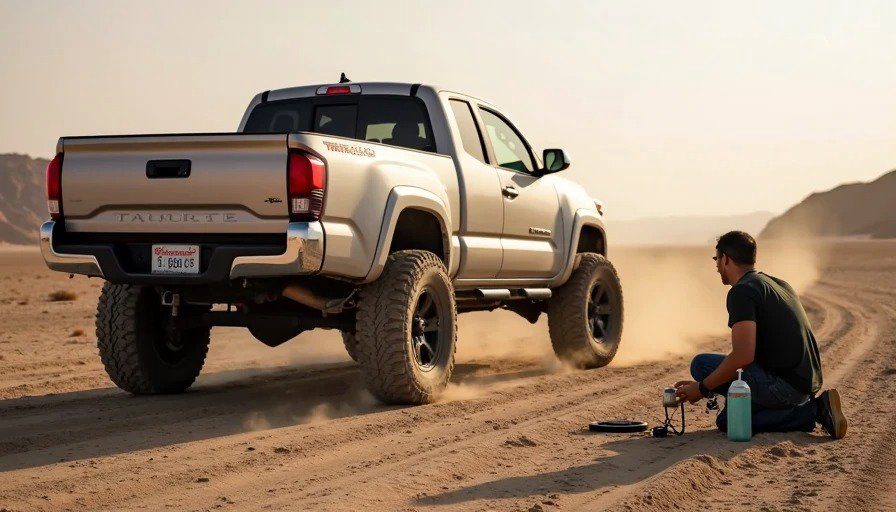
The first flat came forty miles in, just past the Mojave River crossing. The Tacoma's driver-side rear tire went down — not a blowout, just a slow, steady hiss. We pulled over, aired it back up to find the leak, and watched soapy water bubble out of a small cut in the sidewall. Not a puncture. A cut. From a sharp rock on the crossing approach that he'd clipped at the wrong angle.
That's the thing about the Mojave Road: it doesn't punish you for doing something dramatically wrong. It punishes you for the little things. The slightly wrong line. The slightly too-high tire pressure. The decision to save five minutes by not getting out and walking the crossing first.
We swapped in his spare. His full-size spare, which he'd never dropped from under the bed before. Thirty minutes of cranking, cussing, and a torn-up knuckle later, we were rolling again. I made a mental note: check your spare before you leave. Know how to get it down. And don't buy a tire that doesn't come with a matching full-size spare in the first place.
Day Two: The Transmission Starts to Complain
We camped at a spot near Soda Lake — not on the playa itself, because camping on dry lake beds is how you get fined or swallowed, depending on the weather. We found high ground, cooked dinner, and listened to the silence that only the desert can produce. No traffic. No planes. Just wind and the occasional coyote.
The next morning, the temperature was already 85 at 7 a.m. We aired down to 18 psi for the soft stuff and pointed west toward the cinder cone.
That's when the 4Runner started to talk back.
The transmission temp gauge crept up. Not into the red — not yet — but higher than I like to see. 220. 225. I dropped into 4-Lo to keep the torque converter locked and reduce slippage, but the sand was deep, and the outside temp was pushing 110 by noon. The transmission cooler was working, but it was fighting a losing battle against the ambient heat.
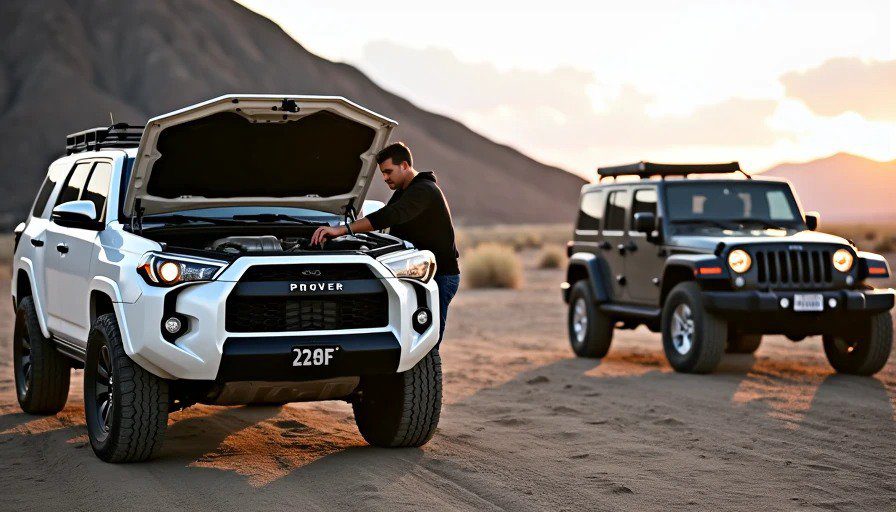
We stopped at the cinder cone — the big black volcanic lump that looks like something out of a Mars rover photo — and I popped the hood to let the engine bay breathe. Heat shimmered off everything. The transmission dipstick was too hot to touch without a rag.
Here's what I should have done differently: put the auxiliary transmission cooler on before this trip. I had one in the garage. I'd been meaning to install it for six months. I kept telling myself "next weekend." And now I was sitting in the middle of the Mojave, watching my transmission fluid degrade with every mile, because I didn't spend three hours on a Saturday in my own driveway.
That's the kind of mistake that's not dramatic. It doesn't leave you stranded. But it reduces the lifespan of your transmission by thousands of miles. And it was entirely preventable.
We took a long lunch under the only patch of shade we could find — the Jeep's awning, which was actually useful for once — and let everything cool down. Two hours later, the temp gauge had dropped back to normal. We pressed on.
Day Three: The Vacuum Line and the Soda Can
We were maybe twenty miles from the end of the road — the western terminus near the 15 — when the engine started running rough. Idle wobbled. Acceleration felt sluggish. I pulled over, popped the hood, and started tracing vacuum lines.
It didn't take long to find the problem. A vacuum line connecting the intake manifold to the EVAP system had cracked right where it bends around a bracket. The rubber had been brittle before we left — I'd noticed it during a pre-trip inspection and thought, "That'll hold until next year."
It didn't hold. It split open on a particularly rough stretch of washboard, and now I had a vacuum leak that made the engine run like it was missing on one cylinder.
I had duct tape. I had zip ties. I had electrical tape. None of those are great for vacuum lines — they either don't seal, or they melt, or both. What I didn't have was a spare piece of vacuum line the right diameter.
What I did have was a can of Coca-Cola I'd been nursing for the last hour. Warm, flat, and mostly full.
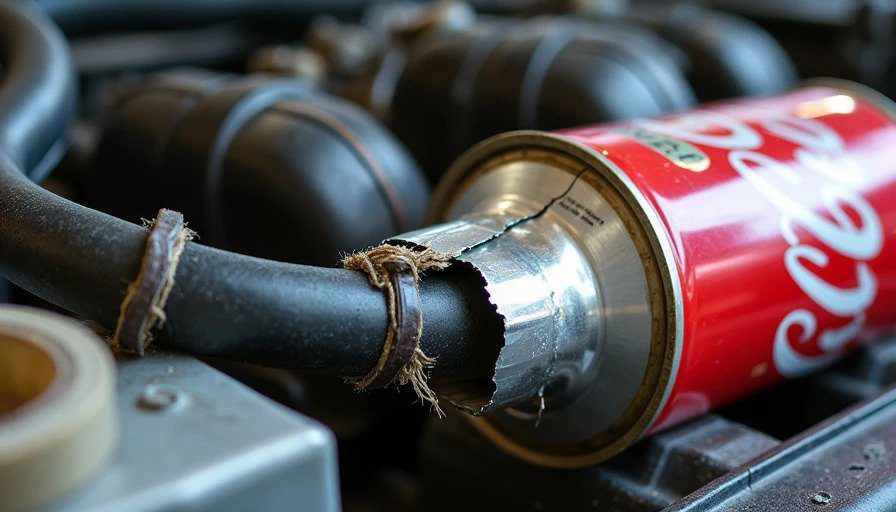
I drained the can, cleaned the inside with a squirt of water from the jerry can, and cut it open with my multi-tool. I unrolled the aluminum into a flat sheet. Then I took that sheet and wrapped it around the cracked vacuum line, snugged it down with two zip ties on either side of the crack, and used electrical tape over the top to seal it.
It wasn't pretty. It wasn't permanent. But it was enough to hold vacuum for the remaining twenty miles.
The engine smoothed out. The idle stabilized. I drove out to pavement that afternoon with a soda can holding my vacuum line together, and I didn't stop smiling the whole way.
What I Brought Home
That trip was three years ago. I still remember every detail — not because it was a dramatic survival story, but because every failure was avoidable.
The flat tire? Avoidable with a better line through the river crossing and tire pressure that was actually appropriate for that terrain.
The overheated transmission? Avoidable by installing the auxiliary cooler I had sitting in my garage.
The cracked vacuum line? Avoidable by replacing a $5 piece of rubber before I left.
None of these were catastrophic. None of them were life-threatening. But all of them were lessons I should have already learned.
Here's the thing about the Mojave Road: it's not the hardest trail in the world. It's not Rubicon. It's not Pritchett Canyon. What it is, is relentless. It never stops shaking your vehicle, never stops sending heat up through the floorboards, never stops testing the parts you didn't think to check. And it doesn't care how much you spent on your build. It only cares about the last time you actually looked under the hood with your own eyes.
I still have that soda can somewhere. I kept it as a reminder. Not because I'm proud of the repair — I'm not — but because it's proof that the best tool on any trail is the one between your ears.
The second-best tool is a full-size spare, a transmission cooler you installed before the trip, and a vacuum line that isn't cracked.
Learn from my mistakes. I'd rather you do that than ask me for a soda can at the trailhead.
Postscript: What I Did After
The vacuum line got replaced the day after I got home. The transmission cooler went in the following weekend. And that spare tire mount? I modified it so the spare drops without a fight now.
The flat tire went up on the wall of the shop. The transmission fluid sample went into a jar next to it. And the soda can? It's on a shelf. Labeled: "Mojave Road, July 2023. 20 miles from pavement. Held vacuum long enough to get out."
It's not a trophy. It's a reminder.
If it hasn't broken in the backcountry, I don't recommend it. And if it's a $5 vacuum line? Don't wait until next weekend.