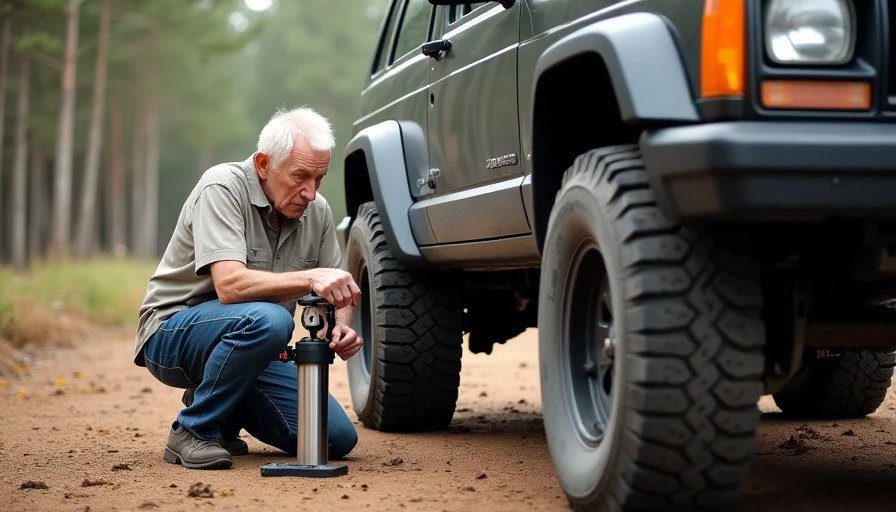
I met Bill at a trailhead in the Coconino National Forest, two years ago. He was parked next to my 4Runner, airing up his tires with an old-school manual pump — the kind you actually have to pump with your arm. His rig was a 1998 Jeep Cherokee XJ, faded red, with a crack in the windshield, a dent in the rear quarter panel, and a bumper held on with hardware store bolts.
I walked over to say hello, mostly because I was curious. I'd just spent $26,000 building my 4Runner, and this guy had pulled up in a truck that looked like it had been through a war and come out the other side.
"Need any help?" I asked.
"Nope," he said. "Just getting the tires back up to pavement pressure. Take about ten minutes."
He was pumping the manual pump, slowly and methodically, and I could see he'd done it a thousand times. The pump had a small pressure gauge attached. He was checking it every few pumps, bringing each tire up to 35 PSI. It took about 12 minutes all up. He didn't seem to mind.
I ended up sitting on the tailgate with him for an hour, talking about his truck. Bill is a retired geologist. He's 68. He bought the Cherokee in 2004, second-hand, with 85,000 miles on it. He's driven it across the Continental Divide twice — once on the Colorado Trail, once on a route through the San Juan Mountains that didn't have a name. He's been through the Mojave Desert, the Utah high desert, the Colorado Rockies, and the Arizona backcountry. He's never been stuck so badly he needed a tow. He's never had a breakdown that couldn't be fixed on the trail.
And the total cost of all his modifications? About $4,500 spread over 15 years.
I asked if I could do a full walkaround. He agreed. I took photos, notes, and a long list of everything he'd done to the truck.
Here's what I learned.
The Vehicle: 1998 Cherokee XJ Sport
Miles: 220,000
Engine: 4.0L inline six (AMC 242)
Transmission: AW4 4-speed automatic
Transfer case: NP231 with 4-Lo
Axles: Front Dana 30, rear Chrysler 8.25
Gearing: 3.55:1 (stock, Bill never changed it)
Suspension: 3-inch lift (more on that later)
Tires: 31x10.5R15 BFGoodrich KO2s
Bill's philosophy is simple: keep it light, keep it simple, keep it reliable. He's not interested in extreme rock crawling. He's interested in getting to remote places, camping for a few days, and driving home without drama.
The Suspension: 3 Inches, No Spacers
Bill's lift is a 3-inch kit from Rubicon Express. He bought the full kit — springs, shocks, leaf packs, and extended brake lines. He installed it himself in his garage 12 years ago.
"Three inches is the sweet spot for the XJ," he told me. "It clears 31s without rubbing, and you can still use the stock driveshaft. Go to 4.5 inches and you need a SYE (slip yoke eliminator) and a new driveshaft. Three inches is easy, cheap, and proven."
The suspension is held together with rubber bushings — not polyurethane, not metal joints. Bill says rubber bushings are quieter and more forgiving on the trail. He replaces them when they crack, and that's about every 50,000 miles.
The shocks are Bilstein 5100s. They're valved for the XJ, and Bill says they're the best value for the money. He's been through three sets. The last set was installed 5 years ago.
Bill's advice: "If you're running 31s, don't overcomplicate the suspension. A 3-inch kit from a good brand, decent shocks, and proper bump stops will get you anywhere you need to go. The rest is just flash."
The Tires and Wheels: 31s on Stock Wheels
Bill runs 31x10.5R15 BFGoodrich KO2s on the factory 5-spoke steel wheels. No spacers. No offset. They fit with the 3-inch lift, and the 10.5-inch width is narrow enough to clear the control arms at full lock.
"I tried 33s once," Bill admitted. "They fit, but they needed more lift, more gearing, and more everything. They were heavy and killed the acceleration. I went back to 31s and never looked back."
Bill's advice: "Tires are the single most important off-road purchase you'll make. Don't buy cheap tires. Buy the best tires you can afford, and keep them at the right pressure. I've been running KO2s for 15 years and I've never had a flat that wasn't my own fault."
The Drivetrain: Stock Gears, One Rear Locker
The engine is bone-stock. 4.0L inline six, 220,000 miles, and it still idles smoothly and pulls strong. Bill does regular oil changes, changes the air filter every 15,000 miles, and doesn't do anything else.
"I've never had an engine problem," Bill said. "The 4.0 is bulletproof. I've replaced the alternator twice, the water pump once, and the starter once. That's it."
The transmission is the AW4, which Bill says is one of the most reliable automatics ever made. He changes the transmission fluid every 30,000 miles and hasn't had a single problem.
The gearing: Stock 3.55:1. Bill never changed it because 31s don't need it. The 4.0 has enough low-end torque to handle the bigger tires without re-gearing.
The rear locker: Bill installed an Aussie Locker in the rear Chrysler 8.25 axle. It's an automatic locker, not selectable.
"It locks up when I need it, unlocks when I don't. You can't feel it on pavement if you drive gently. On the trail, it's a game-changer," Bill said.
The front: Open diff. Bill says he's never needed a front locker. The rear locker handles 95% of the traction situations he encounters.
Bill's advice: "If you're on a budget, put a locker in the rear. That's the single best off-road upgrade you can make. I did the rear locker for $300. It transformed the truck."
The Armor: Minimal but Effective
Bill's armor is minimal by overland standards:
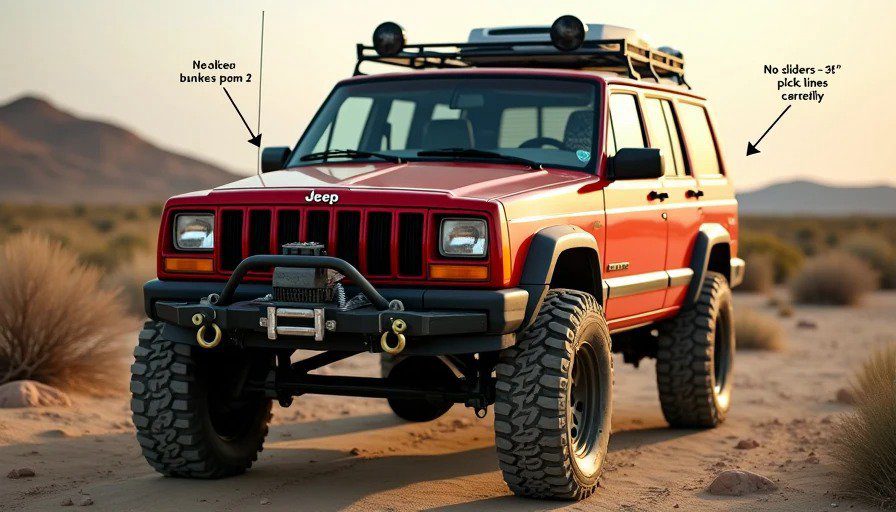
Front bumper: The factory bumper is still on the truck. Bill says it's fine for his use. He's not pushing it through boulders.
Rear bumper: Stock. He did add a tow hitch for recovery points.
Skid plates: The factory skid plates are still on the truck. Bill says the XJ's factory skid plates are actually decent — they cover the transfer case and the front differential.
Rock sliders: None. Bill says he doesn't do the kind of rock crawling that requires sliders. "The XJ has decent clearance for a 3-inch lift. I pick my lines carefully and avoid the big rocks."
Engine oil pan skid: Bill did add a home-made 1/4-inch plate under the oil pan after catching it once in the desert. He cut it from a piece of steel plate and bolted it on. Cost: $20 and a few hours of work.
Bill's advice: "Don't add armor until you need it. I ran the truck for three years without any armor at all. Then I caught the oil pan on a rock in the desert, and I made the skid plate. Run the truck, see what you hit, then armor the vulnerable parts. Don't add weight for the sake of adding weight."
The Recovery Gear: Simple and Reliable
Bill carries exactly what he needs:
Snatch strap: 20-foot, 2-inch strap from ARB
Shackles: Two 3/4-inch recovery shackles
Tree strap: 10-foot tree strap (for the rare occasion he needs it)
Shovel: A cheap folding shovel from a hardware store
Manual tire pump: The one I saw him using when we met. It's a dual-action hand pump that pumps air on both the push and pull stroke. It's a workout, but it works.
Tire plug kit: A basic kit with rubber plugs and a reamer tool
Hand winch: Bill carries a Come-Along hand winch, a 2-ton manual cable winch that he's used twice in 15 years.
"I used the hand winch once to pull a tree off the trail and once to pull myself off a rock I'd high-centered on," he said. "It's slow, but it works. And it doesn't need a battery, a compressor, or anything else."
Bill's advice: "Most people carry more recovery gear than they'll ever need. Carry the basics — a strap, shackles, a shovel, and a plug kit. If you're going somewhere remote, throw in a hand winch or a come-along. You don't need a $2,000 winch setup for most of the trails you'll run."
The Storage: No Drawers, No Fridge, No Fuss
Bill's cargo setup is simplicity itself:
Rear seat removed: He took the rear seats out years ago to save weight and create storage space.
Two plastic bins: One for food, one for gear. He uses big storage totes from the hardware store.
Water: Two 5-gallon jerry cans, strapped to the cargo area floor.
Sleeping: Bill sleeps in a ground tent. No rooftop tent, no RTT rack, no awning.
Cooking: A small two-burner propane stove and a small cooler for the few things that need to stay cold.
"I used to have a fridge," Bill said, "but I sold it after two trips. It took up too much space, used too much power, and I realized I could just eat food that doesn't need refrigeration for three days. I'm not hauling steaks into the backcountry. I'm eating oatmeal, soup, and canned beans."
Bill's advice: "Before you buy a fridge or a rooftop tent, spend a few nights in the backcountry with a tent and a cooler. Figure out what you actually need. Most of us overestimate what we need and underestimate how heavy it gets."
The Electrical: No Dual Batteries, No Solar, Just a Jump Pack
Bill's truck has a single battery — an Optima Yellow Top he bought 5 years ago. He uses a small 200W inverter for his laptop and camera, but he doesn't use it much.
"I don't have a fridge, I don't have a winch, I don't have lights that need 50 amps," Bill said. "I don't need a dual battery setup. I carry a NOCO jump pack in the glovebox, just in case. I've used it once, when the kid camping next to me left his lights on."
Bill's advice: "If you don't need the power, don't carry the weight. You'd be surprised how far you can get with just your starter battery and a jump pack."
The Reliability Philosophy: Keep It Stock Where It Counts
Bill's approach to reliability is simple: keep the critical parts original, and don't modify them until they break.
Here's what he hasn't modified:
Engine: Stock, with regular maintenance
Transmission: Stock, with regular fluid changes
Transfer case: Stock, with regular fluid changes
Driveshafts: Stock (he kept the 3-inch lift to avoid replacing the driveshaft)
Electrical system: Stock
Here's what he's replaced when they failed:
Alternator: Twice (120,000 miles and 180,000 miles)
Water pump: Once (160,000 miles)
Starter: Once (140,000 miles)
Radiator: Once (150,000 miles)
Bill's advice: "If it works, don't touch it. The factory designed these parts to last. When something fails, replace it with a quality part — not a 'performance' part, not a 'heavy-duty' part — just a quality OEM or OEM-equivalent part."
The Biggest Surprise: Bill's One Piece of Advice
At the end of our conversation, Bill said something that stuck with me.
"You know what the best mod is?"
"Tell me."
"Practice. Spend a weekend in your driveway. Change a tire. Change a belt. Do an oil change. Know how to fix your truck before it breaks on the trail. Most people spend $20,000 on mods and don't know how to change their own spare tire. That's wrong."
"I've never been stuck because I had the wrong part. I've been stuck because I didn't know how to fix what broke, or because I didn't have the right tool. The first time I blew a tire on the trail, I had a full-size spare, but I didn't have a jack that could lift the truck high enough. I had to dig a hole under the axle to get the jack under it. That was 10 hours and a lot of swear words."
"Spend the money on tools, not on parts."
What Bill's XJ Teaches Us
Here's what I took away from Bill's XJ:
You don't need a $50,000 build to get deep into the backcountry. Bill's XJ cost him $5,500 total (truck plus mods), and it's been more reliable than most $50,000 builds I've seen.
Simplicity is reliability. The fewer parts you have, the fewer parts can break. Bill's XJ doesn't have a dual battery system, a rooftop tent, a winch, a fridge, a drawer system, or an awning. It doesn't need them.
Weight is the enemy. Bill's XJ weighs about 4,200 pounds fully loaded. My 4Runner weighs 5,800 pounds fully loaded. That's 1,600 pounds of difference. He's easier on the suspension, better on fuel, and less likely to get stuck.
Start small and build as you need. Bill didn't add armor until he hit something. He didn't add a locker until he got stuck. He didn't add a lift until he started hitting his bump stops. He built the truck in response to what he actually needed, not what a catalog said he needed.
Tools and skills are better than parts. Bill's recovery gear is basic, but his tool kit is comprehensive. He carries a full socket set, wrenches, screwdrivers, and a multimeter. He knows how to use all of them.
Don't be afraid to look stock. Bill's XJ doesn't look like a magazine build. It's faded, dented, and held together with hardware store bolts. And it's been everywhere.
What I'd Do Differently
I asked Bill if there was anything he'd change.
He thought about it for a minute.
"I'd add a second spare tire. I've had two flats on one trip before, and it was a long walk to get a second tire. I'd also add better lights. The XJ's stock headlights are terrible."
"And I'd get a better bumper. The factory bumper has saved me a few times, but it's not designed for recovery. I'd swap it out for a basic front bumper with a recovery point."
The Takeaway
Bill's XJ is not a show truck. It's a working truck — a truck that has been to remote places, crossed mountains, driven through deserts, and come back without a tow.
It's a testament to the philosophy that you don't need to spend a lot of money to get a lot of value. You need a reliable platform, smart mods, and the willingness to learn.
And you need to carry the right tools and know how to use them.
The Parts Graveyard Connection: Bill's Dashboard
Bill has a small collection of parts on his dashboard. Not for show — for reference.
There's a broken alternator bolt, a melted vacuum line, a snapped lug stud, and a cracked relay. Each one has a story, and Bill's told me a few of them.
The broken alternator bolt: "This is from the Mojave Road. I'd been driving with a loose bolt for a few hundred miles, and it snapped on a washboard section. The alternator started wobbling and stopped charging. I had to replace the bolt on the trail. I used an old tent stake as a temporary bolt."
The melted vacuum line: "This is from the Continental Divide trip. The vacuum line melted on the exhaust manifold because I'd routed it too close. The engine lost power, and I had to patch it with duct tape and a soda can. The redneck repairs work if you know how to do them."
The snapped lug stud: "This is from a simple tire change. I over-torqued the lug nut and snapped the stud. I should have used a torque wrench, but I didn't have one. Now I carry a torque wrench."
The cracked relay: "This is from the alternator failure. The relay was old and cracked. The contact was burned. I've replaced all the relays in the truck now, but this one's a reminder."